
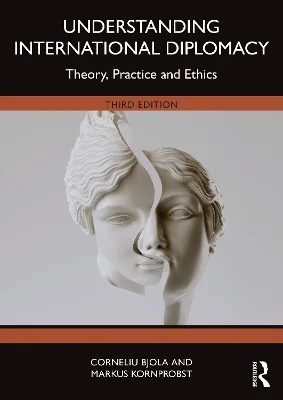
Description
By (author) Bjola Corneliu; By (author) Kornprobst Markus
Short /annotation:
This textbook provides a comprehensive introduction to the study of international diplomacy, covering both theory and practice. The third edition has been updated and revised, with new chapters on the digital turn, contemporary crises and power shifts in modern diplomacy.
:
This textbook provides a comprehensive introduction to the study of international diplomacy, covering both theory and practice. The third edition has been updated and revised, with new chapters on the digital turn, contemporary crises, and power shifts in modern diplomacy.
By integrating historical traditions from Europe, China, and the Middle East with modern diplomatic challenges, this book:
- Traces the evolution of diplomacy from its historical foundations to its modern institutionalised form, examining how shifting power dynamics, technological revolutions, and geopolitical crises have shaped its trajectory
- Examines theoretical perspectives on diplomacy as a communicative practice, exploring how diplomats interpret and project power, negotiate international norms, and sustain diplomatic agency in an increasingly fragmented world order
- Analyses diplomacy in the digital age, investigating how new technologies, social media, and artificial intelligence reshape diplomatic interactions, redefine state and non-state engagement, and challenge traditional diplomatic norms in a rapidly evolving global information environment.
This new edition offers an up-to-date, accessible, and authoritative overview of how diplomacy works and, indeed, ought to work in a globalised world. It will be essential reading for students of international diplomacy and is highly recommended for students of crisis negotiation, international organisations, foreign policy, and international relations.
Table of contents:
PART I: INTRODUCTION 1 Why and how to study diplomacy
PART II: TRACING DIPLOMACY 2 Historical Evolution 3 Central Themes of Diplomatic Thought 4 Expansion and Contraction of Diplomacy
PART III: MAPPING DIPLOMACY 5 Contexts of Diplomacy 6 Tasks of Global Diplomacy
PART IV: EXPLAINING DIPLOMACY 7 Making Judgments 8 Making Relations 9 Making Order
PART V: REMAKING DIPLOMACY 10 The Digital Turn 11 Crises in the Inter-epoch 12 Diplomatic Power
PART VI: CONCLUSION 13 The Philosophy of Diplomacy
Review quote:
Praise for the Second Edition:
‘Writing with clarity, authority and insight Bjola and Kornprobst deliver the essential introduction to the study and practice of diplomacy. The welcome second edition includes new scholarship and tackles the emerging issues that are defining our time including migration and the crises in Syria and Ukraine. No less significantly, the volume also considers new techniques of diplomacy from social media to the emergence of cities as foreign policy actors. This book is an invaluable guide to a vital field.’– Nicholas J. Cull, Professor of Public Diplomacy, University of Southern California.
”In many ways superior to the original, the revised edition updates the evolution and transformation of diplomacy, more balanced in theory and practice, wide in scope and succinct in narration, a rich menu for both students and practitioners of diplomacy.” — Zhang Qingmin, Professor and Chair, Department of Diplomacy Peking University
”Adopting a broad understanding of diplomacy and taking us on an exciting tour — from foreign policy implementation to ethics, from bilateral engagements to plurilateral and paradiplomatic ones, from traditional channels to new forms of diplomatic communication — Understanding International Diplomacy is a welcome and valuable addition to the expanding field of diplomat


Reviews
There are no reviews yet.