
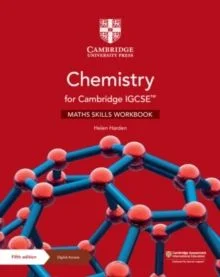
Description
By (author) Harden Helen
:
Skills focused series for examination from 2023; inspired by teachers, for teachers.The maths skills workbook with digital access helps learners to develop their maths skills in the context of the Cambridge IGCSE™ Chemistry syllabus, based on research carried out by the Nuffield Foundation and the Association for Science Education. Practice exercises, which increase in complexity, provide opportunities for learners to practise each maths skill. Worked examples help learners develop their thinking processes and include further help with ”Key questions to ask yourself”. The ”Look out” feature makes students aware of common misconceptions. Practice and exam-style questions help students improve their fluency and confidence in answering questions. The answers can be found online at www.cambridge.org/go
Table of contents:
How to use this series; How to use this book; Introduction; Maths skills grid; 1. Representing values; Maths focus 1: Using units; Maths skill 1: Choosing the correct unit; Maths skill 2: Writing the unit symbol; Maths skill 3: Writing symbols for derived units; Maths focus 2: Understanding very large and very small numbers; Maths skill 1: Understanding place value; Maths skill 2: Understanding powers of10; Maths skill 3: Understanding unit prefixes; Maths focus 3: Writing numbers in a required form; Maths skill 1: Writing numbers in standard form; Maths skill 2: Writing numbers to the required number ofsignificant figures; 2. Working with data; Maths focus 1: Collecting data; Maths skill 1: Reading scales; Maths skill 2: Recording to the correct number ofdecimal places; Maths focus 2: Understanding types ofdata; Maths skill 1: Identifying independent and dependent variables; Maths skill 2: Distinguishing categorical, continuous and discrete data; Maths focus 3: Recording and processing data; Maths skill 1: Drawing tables; Maths skill 2: Drawing tables to help process data; Maths skill 3: Recording processed data to the correct number ofsignificant figures; 3. Drawing charts and graphs; Maths focus 1: Drawing bar charts; Maths skill 1: Choosing a suitable scale for the vertical axis (y-axis); Maths skill 2: Drawing the bars; Maths focus 2: Drawing pie charts; Maths skill 1: Converting percentages to angles; Maths skill 2: Drawing the sectors; Maths focus 3: Drawing line graphs; Maths skill 1: Choosing which variable goes on which axis; Maths skill 2: Drawing the axes; Maths skill 3: Plotting the data points; Maths skill 4: Using a ruler to draw a best-fit line; Maths skill 5: Drawing a best-fit curve freehand; 4. Interpreting data; Maths focus 1: Interpreting charts; Maths skill 1: Interpreting the heights ofbars on a bar chart; Maths skill 2: Comparing the sizes ofsectors on a pie chart; Maths focus 2: Reading values from a line graph; Maths skill 1: Interpolating line graphs; Maths skill 2: Extrapolating line graphs; Maths skill 3: Finding the intercept; Maths focus 3: Interpreting the shape ofline graphs; Maths skill 1: Recognising the shape ofthe graph; Maths skill 2: Interpreting the changing gradient ofa curve; Maths skill 3: Calculating the gradient ofa straight-line graph; 5. Doing calculations; Maths focus 1: Using basic mathematical operations in calculations; Maths skill 1: Working out the correct calculation for relative formula mass; Maths skill 2: Using mathematical operations in the correct order to calculate relative formula mass; Maths skill 3: Calculating number ofparticles using powers of10 (Supplement); Maths skill 4: Using positive and negative values to interpret the overall enthalpy change ofa chemical reaction (Supplement); Maths focus 2: Calculating and using percentages; Maths skill 1: Calculating percentage composition by mass; Maths skill 2: Calculating percentage yield; Maths skill 3: Calculating percentage purity; Maths skill 4: Using percentages to calculate relative atomic mass; M


Reviews
There are no reviews yet.