
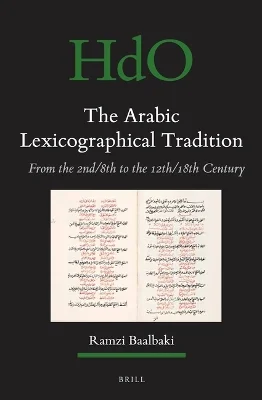
Description
By (author) Baalbaki, Ramzi
Short /annotation:
A comprehensive and methodologically sophisticated history of Arabic lexicography, this book examines the aims, range, and approaches of the most important writings and writers of lexica specialized in specific topics and multi thematic thesauri, and the lexica arranged according to roots.
:
A comprehensive and methodologically sophisticated history of Arabic lexicography, this book fills a serious gap in modern scholarship. Besides meticulously examining the factors that led to the emergence of lexicographical writing as of the second/eighth century, the work comprises detailed discussions of the aims, range, and approaches of the most important writings and writers of lexica specialized in specific topics and multi thematic thesauri, and the lexica arranged according to roots. The organisation of the book and the lists of works cited in the various genres make it easy for the reader to find his way through an enormous amount of material. From a broader perspective, the book highlights the relationship between Arabic lexicography and other areas of linguistic study, grammar in particular, and the centrality of Qurʾan and poetry to lexicographical writing.
Table of contents:
PrefaceChapter One: Early Lexicographical Activity1. The Background of Linguistic Study2. The Speech of the Bedouins (Aʿrāb)3. The Collection of Data4. The Epochs of Reliable Usage (ʿUṣūr al-iḥtiǧāǧ)5. The Role of Ġarīb6. The Compilation of Lexica7. Remarks on Contemporary Scholarship and the Originality of Arabic LexicographyChapter Two: Mubawwab (Onomasiological) and Specialized Lexica1. Introduction2. al-Ġarīb (Strange Usage) and al-Nawādir (Rare Usage)3. al-Amṯāl (Proverbs)4. al-Nabāt (Plants), al-Ḥayawān (Animals), Ḫalq al-insān (Human Body), etc.5. al-Muʿarrab (Arabized Words)6. Laḥn al-ʿāmma (Solecism)7. al-Aḍdād (Words with Two Contradictory Meanings)8. al-Muštarak (Homonyms) and al-Mutarādif (Synonyms)9. al-Ḥurūf/al-Aṣwāt (Particles/Letters)10. al-Abniya (Morphological Patterns)11. Multithematic WorksChapter Three: Muǧannas (Semasiological) Lexica1. Introduction2. The Phonetic-Permutative System3. The Alphabetical System4. The Rhyme SystemEpilogueBibliographical ReferencesIndices
Review quote:
“Be that Baalbaki’s study on Mugannas, on Semasiological Lexica (from sign to meaning) and the contradiction with the mubawwab lexica (from meaning to sign) or the development of the Arabic language as a result of the conquests, readership of this a book naturally includes sociologists of language, anthropologists, ethnologists and theologians.”
Stavros Nikolaidis in Journal of Oriental and African Studies 28 (2019)
“…eine willkommene und fundierte Ergänzung der Literatur über die arabische Lexikographie”.
Vivian Strotmann in Die Welt des Islams 57 (2017) 227-229.
“This work will be extremely helpful for specialists, but it is also accessible to non-specialists, and does a wonderful job of expressing why Arabic lexicography is relevant and interesting even for those who do not speak Arabic. It allows readers to challenge their preconceptions about dictionaries and the kind of work that dictionaries do.”
David Lennington in Al-Abhath 64 (2016)
“Ramzi Baalbaki, the very renowned researcher on the history of Arabic Language and Linguistics, after long years of extensive publication in the field, provides the reader with this seminal work on the Lexicographical Arabic tradition. It is indeed a milestone in the history of studies on the extremely rich tradition of Arabic Lexical works, as well as a good reference for everybody interested in discovering the subtleties and intricacies of the Arabic language. […] This is definitely a solid piece of research, an impressive work that provides an invaluable service to researchers



Reviews
There are no reviews yet.