
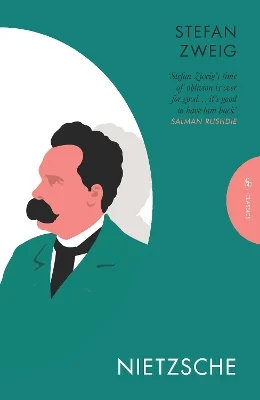
Description
By (author) Zweig, Stefan; Translated by Stone Will
Short /annotation:
A dazzling, tour de force biography of the one of the greatest philosophers of the nineteenth century, by one of the bestselling writers of the twentieth.
:
A compelling portrait of one of the greatest philosophers of the nineteenth century, by one of the bestselling writers of the twentieth.In this vivid biographical study, Zweig eschews traditional academic discussion and focuses on Nietzsche”s habits, passions and obsessions. Concentrating on the man rather than the work, on his tragic isolation and volatile creativity, Zweig draws the reader inexorably into the drama of Nietzsche”s life.
Review quote:
Zweig”s accumulated historical and cultural studies [are] almost too impressive to take in
Review quote:
Zweig is the most adult of writers; civilised, urbane, but never jaded or cynical; a realist who none the less believed in the possibility – the necessity – of empathy
Review quote:
Zweig… deserves to be famous again, and for good
Biographical note:
Stefan Zweig was one of the most popular and widely translated writers of the early twentieth century. Born into an Austrian-Jewish family in 1881, he became a leading figure in Vienna”s cosmopolitan cultural world and was famed for his gripping novellas and vivid psychological biographies.In 1934, following the Nazis” rise to power, Zweig fled Austria, first for England, where he wrote his famous novel Beware of Pity, then the United States and finally Brazil. It was here that he completed his acclaimed autobiography The World of Yesterday, a lament for the golden age of a Europe destroyed by two world wars. The articles and speeches in Messages from a Lost World were written as Zweig, a pacifist and internationalist, witnessed this destruction and warned of the threat to his beloved Europe. On 23 February 1942, Zweig and his second wife Lotte were found dead, following an apparent double suicide.
Excerpt:
I
Tragedy without a Cast
To profit most from existence, man must live dangerously.
The tragedy of Friedrich Nietzsche is a monodrama: no other
figure is present on the brief lived stage of his existence. Across
the acts of this tragedy, which crash down and surge on like
an avalanche, the isolated combatant stands alone beneath
the stormy sky of his own destiny; nobody is alongside him,
nobody is opposing him and no woman is there to momentarily
relax the overstrung atmosphere with her presence. Every
movement issues from him alone and he is its sole witness:
the few figures who at the outset linger in his shadow can only
accompany his heroic enterprise with gestures of dumb astonishment
and alarm and little by little distance themselves from
him as if from some danger. Not a single being dare properly
enter the inner sanctum of that destiny; always Nietzsche
speaks, struggles, suffers for himself alone. He addresses no
one and no one responds. Worst of all: no one is even listening.
There are no other people, no fellows, no listeners in this
unique tragedy of Friedrich Nietzsche, but neither is there a
stage, scenery or costume, for it plays out, so to speak, only in
the airless space of the idea. Basel, Naumburg, Nice, Sorrento,
Sils-Maria, Genoa, these names were not those of Nietzsche’s
homes, but merely a series of milestones along a road travelled
in a burning flight, the cold colourless wings of the theatre.
In truth the scene of this tragedy always remains the same:
isolation, solitude, that cruelly wordless responseless solitude
that his thought carries within and around itself like an opaque
bell-jar, a solitude without flowers or colours, without sounds,
animals




Reviews
There are no reviews yet.