
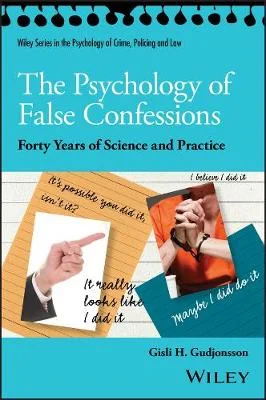
Description
By (author) Gudjonsson Gisli H.
Short /annotation:
Provides a comprehensive and up–to–date review of the development of the science behind the psychology of false confessions
Four decades ago, little was known or understood about false confessions and the reasons behind them. So much has changed since then due in part to the diligent work done by Gisli H. Gudjonsson.
:
Provides a comprehensive and up–to–date review of the development of the science behind the psychology of false confessions
Four decades ago, little was known or understood about false confessions and the reasons behind them. So much has changed since then due in part to the diligent work done by Gisli H. Gudjonsson. This eye–opening book by the Icelandic/British clinical forensic psychologist, who in the mid 1970s had worked as detective in Reykjavik, offers a complete and current analysis of how the study of the psychology of false confessions came about, including the relevant theories and empirical/experimental evidence base. It also provides a reflective review of the gradual development of the science and how it can be applied to real life cases.
Based on Gudjonsson’s personal account of the biggest murder investigations in Iceland’s history, as well as other landmark cases, The Psychology of False Confessions: Forty Years of Science and Practice takes readers inside the minds of those who sit on both sides of the interrogation table to examine why confessions to crimes occur even when the confessor is innocent. Presented in three parts, the book covers how the science of studying false confessions emerged and grew to become a regular field of practice. It then goes deep into the investigation of the mid–1970s assumed murders of two men in Iceland and the people held responsible for them. It finishes with an in–depth psychological analysis of the confessions of the six people convicted.
- Written by an expert extensively involved in the development of the science and its application to real life cases
- Covers the most sensational murder cases in Iceland’s history
- Deep analysis of the `Reykjavik Confessions’ adds crucial evidence to understanding how and why coerced–internalized false confessions occur, and their detrimental and lasting effects on memory
The Psychology of False Confessions: Forty Years of Science and Practice is an important source book for students, academics, criminologists, and clinical, forensic, and social psychologists and psychiatrists.
Table of contents:
About the Author xv
Series Preface xvii
Preface xxi
Acknowledgements xxv
Icelandic Names xxvii
Introduction 1
A Brief Review of my Cases on Disputed Confessions (1980–2016) 3
The Structure and Content of the Book 4
The Gudmundur and Geirfinnur Cases 6
Part I: The Emerging Science and Practice 9
1 An Era of Enquiry and Development 11
My Early Research on Lie Detection 13
The Sunday Times Experiment 18
British Psychological Society Committees on Lie Detection 20
Onward and Upward 22
Conclusions 24
2 The Impact of Real]Life Cases on Legal Changes, Police Practice, and Science 27
The Confait Case 28
The Guildford Four 31
The Birmingham Six 35
The Tottenham Three (Engin Raghip) 37
The Case of Judith Ward 38
The Cardiff Three (Stephen Miller) 39
The PEACE Model of Interviewing 45
Summary and Conclusions 48
3 Interrogative Suggestibility 51
The Experimental Approach 52
The Individual Differences Approach 54
The Gudjonsson and Clark Model 59
Conclusions 61
4 The Psychology of False Confessions: The Theories 63
Definitions of False Conf




Reviews
There are no reviews yet.