
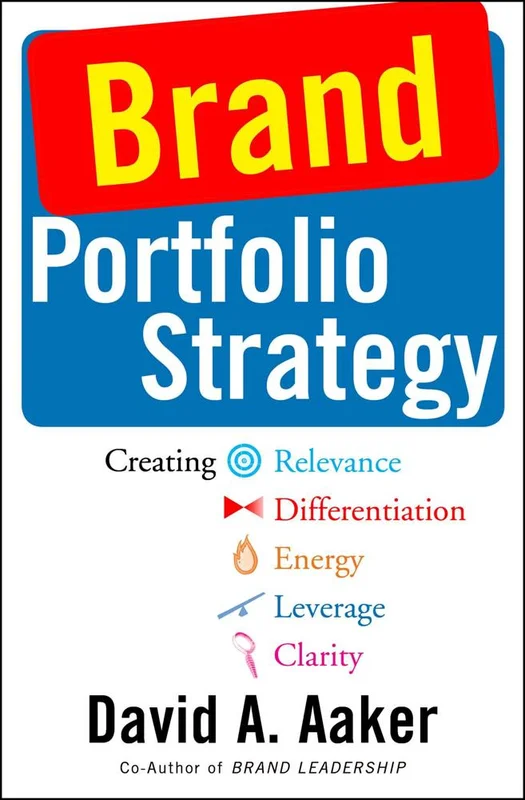
Description
By (author) Aaker David A.
:
In this long-awaited book from the world’s premier brand expert and author of the seminal work Building Strong Brands, David Aaker shows managers how to construct a brand portfolio strategy that will support a company’s business strategy and create relevance, differentiation, energy, leverage, and clarity.
Building on case studies of world-class brands such as Dell, Disney, Microsoft, Sony, Dove, Intel, CitiGroup, and PowerBar, Aaker demonstrates how powerful, cohesive brand strategies have enabled managers to revitalize brands, support business growth, and create discipline in confused, bloated portfolios of master brands, subbrands, endorser brands, cobrands, and brand extensions.
Renowned brand guru Aaker demonstrates that assuring that each brand in the portfolio has a clear role and actively reinforces and supports the other portfolio brands will profoundly affect the firm’s profitability. Brand Portfolio Strategy is required reading not only for brand managers but for all managers with bottom-line responsibility to their shareholders.
Biographical note:
David A. Aaker is the Vice-Chairman of Prophet, Professor Emeritus of Marketing Strategy at the Haas School of Business, University of California at Berkeley, Advisor to Dentsu, Inc., and a recognized authority on brands and brand management. The winner of the Paul D. Converse Award for outstanding contributions to the development of the science of marketing and the Vijay Mahajan Award for Career Contributions to Marketing Strategy, he has published more than ninety articles and eleven books, including Strategic Market Management, Managing Brand Equity, Building Strong Brands, and Brand Leadership (coauthored with Eric Joachimsthaler).
Excerpt:
Chapter 1: Brand Portfolio StrategyCHAPTER 1BRAND PORTFOLIO STRATEGY
We hire eagles and teach them to fly in formation.
—D. WAYNE CALLOWAY, FORMER CEO OF PEPSICO
You don’t get harmony when everyone sings the same note.
—DOUG FLOYD
Nobody has ever bet enough on a winning horse.
—RICHARD SASULY
THE INTEL CASE
During the 1990s, Intel achieved remarkable success in terms of increase in sales, stock return, and market capitalization.I Sales of its microprocessors went from $1.2 billion in 1989 to more than $33 billion in 2000. Its market capitalization grew to more than $400 billion in just over thirty years. Intel’s ability and willingness to reinvent its product line again and again—making obsolete business areas in which it had big investments—certainly played a key role in its success. Its operational excellence in creating complex new products with breathtaking speed and operating microprocessor fabrication plants efficiently and effectively was also critical.
Intel’s brand portfolio strategy, however, played a critical role as well. And this brand portfolio strategy could not have emerged without the brilliance of Dennis Carter, Intel’s marketing guru during the 1990s, and the support of Andy Grove at the very top of the organization. Few organizations, particularly in the high-tech sector, are blessed with such assets.
Intel’s brand story really starts in 1978, when it created the 8086 microprocessor chip, which won IBM’s approval to power its first personal computer. The Intel chip and its subsequent generations (the 286 in 1982, the 386 in 1985, and the 486 in 1989) defined the industry standard and was the dominant brand.
In early 1991, Intel was facing pressure from competitors exploiting the fact that Intel failed to obtain trademark protection on the X86 series. These firms created confusion by calling their “clone” products names like the AMD386, implying that they were as effective as any other 386-powered PC.
To respond to this




Reviews
There are no reviews yet.