
Description
By (author) Aspinall Helen C.
Short /annotation:
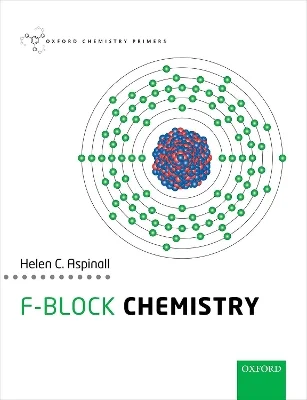
f-Block Chemistry presents the most important underlying themes of f-element chemistry, illustrating these themes with carefully chosen examples.
:
The renowned Oxford Chemistry Primers series, which provides focused introductions to a range of important topics in chemistry, has been refreshed and updated to suit the needs of today”s students, lecturers, and postgraduate researchers. The rigorous, yet accessible, treatment of each subject area is ideal for those wanting a primer in a given topic to prepare them for more advanced study or research. Moreover, cutting-edge examples and applications throughout the texts show the relevance of the chemistry being described to current research and industry.The learning features provided, including questions at the end of every chapter and online multiple-choice questions, encourage active learning and promote understanding. Furthermore, frequent diagrams, margin notes, further reading, and glossary definitions all help to enhance a student”s understanding of these essential areas of chemistry.f-Block Chemistry presents the most important underlying themes of f-element chemistry, illustrating these themes with carefully chosen examples. Online resources:The online resources that accompany f-Block Chemistry feature:For students:- Multiple-choice questions for self-directed learning- Additional ”Deeper Look” content For registered adopters of the text:- Figures from the book available to download
Table of contents:
1: The fundamentals2: Electronic structure, magentism and spectroscopy3: Binary compounds4: Coordination chemistry5: Organometallic chemistry6: Applications7: Extraction and purification of lanthanoids and actinoids
Review quote:
[The text is] extremely clear and easy to follow. I really like the fact that applications are brought in. Even when they are referred to in later chapters, it gives the learner the possibility to see the ”point” of learning the material and why it is important.
Review quote:
Although this is a Primer and meant to be a good summary of the material concerned, I consider it to be excellent for most undergraduate module needs, and I would have no hesitation in adopting this text for my current short course within a module at FHEQ Levels 6 & 7.
Biographical note:
Helen C. Aspinall is Professor of Chemistry at the University of Liverpool. She completed her BSc and PhD at UCL, and then continued her postdoctoral research at Columbia University in New York and then Queen Mary College in London. Her research is largely based around chemistry of lanthanide elements. Her teams have developed new lanthanide-based catalysts and, through collaboration with materials scientists at Liverpool, developed precursors for the growth of thin films of lanthanide (and other metal) oxides.
Publisher’s notice:
Helen C. Aspinall is Professor of Chemistry at the University of Liverpool. She completed her BSc and PhD at UCL, and then continued her postdoctoral research at Columbia University in New York and then Queen Mary College in London. Her research is largely based around chemistry of lanthanide elements. Her teams have developed new lanthanide-based catalysts and, through collaboration with materials scientists at Liverpool, developed precursors for the growth of thin films of lanthanide (and other metal) oxides.
Version history:
Examples and applications presented throughout help students to see the relevance of the subject to current research and industry, such as concerns about availability of rare earths for applications in clean technology and the debates around the safety of nuclear power and the resulting wasteFrequent diagrams, margin notes, and glossary definitions support students in their learningQuestions at the end of every cha


Reviews
There are no reviews yet.