
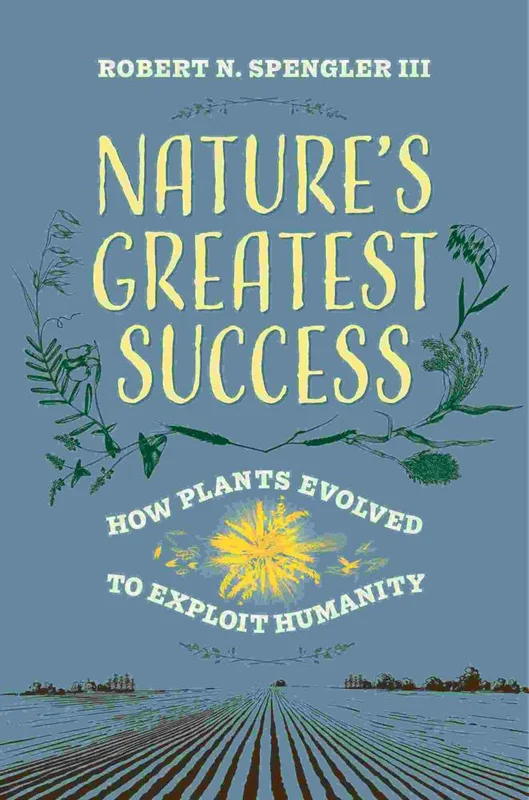
Description
By (author) Spengler Robert N.
:
The 15,000-year story of how grass seduced humanity into being its unwitting labor force—and the science behind it.
Domesticated crops were not human creations, and agriculture was not simply invented. As Robert N. Spengler shows, domestication was the result of an evolutionary process in which people played a role only unwittingly and as actors in a numberless cast that spanned the plant and animal kingdoms. Nature”s Greatest Success is the first book to bring together recent scientific discoveries and fascinating ongoing research to provide a systematic account of not only how agriculture really developed but why.
Through fifteen chapters, this book dives deep into the complex processes that drove domestication and the various roles that plants and animals, including humans, played in bringing about those changes. At the intersection of popular history, archaeology, and evolutionary biology, Nature”s Greatest Success offers a revolutionary account of humanity not at the apex of nature but deeply embedded in the natural world and the evolutionary processes that continue to guide it even today.
Table of contents:
Contents
Preface
1. The Domestication Age
2. What Is Domestication?
3. Domestication Is Occurring All around You
4. Reframing Domestication as Evolution
5. Domestication Was Inevitable
6. Adaptability and Domestication
7. Developmental Plasticity
8. Weed Domestication
9. Evolutionary Origins of Farming
10. Natura Non Facit Saltum
11. Primate Orchards
12. Megafruits
13. Small-Seeded Annuals
14. The Insularity Syndrome
15. Visualizing the Origins
Afterword
Common and Scientific Names
Notes
References
Index
Review quote:
“An astute overview of a burning historical controversy.”
Review quote:
“Spengler (Max Planck Institute of Geoanthropology) examines the mutualistic relationships between humans and plants, using modern examples from anthropogenic landscapes to understand ancient patterns and the earliest traits of domestication. . . . This would be an ideal text for an ecology or evolution seminar or a discussion course.”
Review quote:
“In Nature’s Greatest Success, Robert Spengler argues that domestication began not as a conscious human endeavor, but an emergent evolutionary process shaped by the removal of ecological pressures by human activity.”
Review quote:
“Spengler explore[s] how human beings unwittingly contribute to plant and animal change and survival. . . . [B]rilliant.”
Review quote:
“Nature’s greatest success is . . . replete with evident great scholarship on the part of the author.”
Biographical note:
Robert N. Spengler III directs the Fruits of Eurasia: Domestication and Dispersal research project and leads the Domestication and Anthropogenic Evolution Research Group at the Max Planck Institute of Geoanthropology in Jena, Germany. He is author of the book Fruit from the Sands and has published dozens of scholarly articles while running research projects across Central Asia.
Primary cover copy:
“A compelling case for decoupling domestication from the yoke of human dominance and intentionality and instead understanding it as a pervasive and ages-old coevolutionary process. Spengler integrates and updates archaeological and biological data and theory more successfully and comprehensively than anyone I have seen. Scholars reluctant to relinquish human agency as the force driving domestication may be persuaded that multispecies, mutualistic relationships at the core of modern agriculture were not only ”natural” as opposed to ”cultural” but arguably inevit



Reviews
There are no reviews yet.