
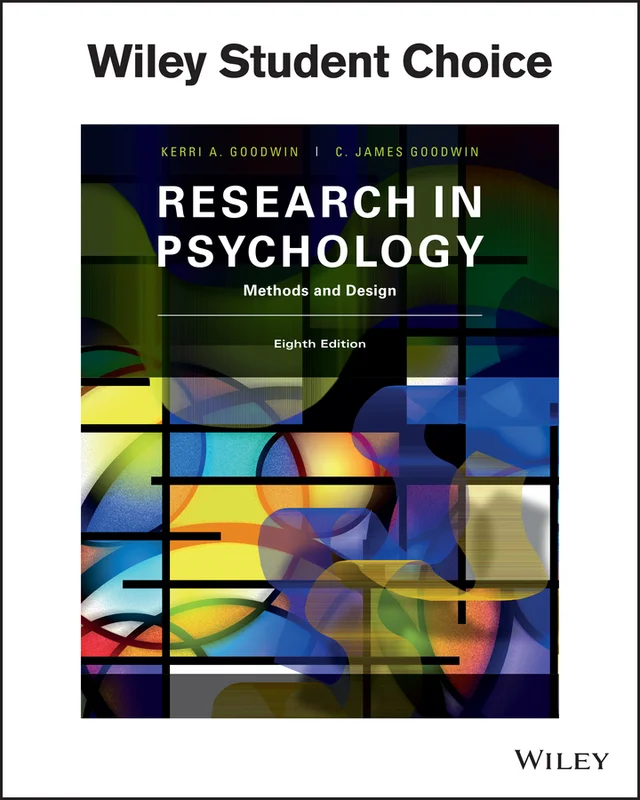
Description
By (author) Goodwin Kerri A.; By (author) Goodwin C. James
:
An approachable, coherent, and important text,
Research in Psychology: Methods and Design, 8th Edition continues to provide its readers with a clear, concise look at psychological science, experimental methods, and correlational research in this newly updated version. Rounded out with helpful learning aids, step-by-step instructions, and detailed examples of real research studies makes the material easy to read and student-friendly.
Table of contents:
Summary of Research Examples xv
Preface xvii
1 Scientific Thinking in Psychology 1
Why Take This Course? 2
Ways of Knowing 5
Authority 5
Use of Reason 5
Empiricism 6
The Ways of Knowing and Science 8
Science as a Way of Knowing 9
Science Assumes Determinism 9
Science Makes Systematic Observations 10
Science Produces Public Knowledge 10
Box 1.1: ORIGINS—A Taste of Introspection 11
Science Produces Data‐Based Conclusions 12
Science Produces Tentative Conclusions 13
Science Asks Answerable Questions 14
Science Develops Theories That Can Be Falsified 14
Psychological Science and Pseudoscience 15
Recognizing Pseudoscience 16
Associates with True Science 17
Box 1.2: CLASSIC STUDIES—Falsifying Phrenology 18
Relies on Anecdotal Evidence 19
Sidesteps the Falsification Requirement 20
Reduce Complex Phenomena to Overly Simplistic Concepts 21
The Goals of Research in Psychology 21
Describe 21
Predict 22
Explain 22
Apply 22
A Passion for Research in Psychology 23
Eleanor Gibson (1910–2002) 24
B. F. Skinner (1904–1990) 25
2 Ethics in Psychological Research 30
Box 2.1: CLASSIC STUDIES—Infants at Risk 31
Developing a Code of Ethics for Psychological Science 32
Ethical Guidelines for Research with Humans 35
Weighing Benefits and Costs: The Role of the IRB 35
Informed Consent and Deception in Research 38
Box 2.2: ETHICS—Historical Problems with Informed Consent 39
Informed Consent and Special Populations 41
Use of Deception 42
Treating Participants Well 43
Research Ethics and the Internet 46
Ethical Guidelines for Research with Animals 47
Animal Rights 48
Box 2.3: ORIGINS—Antivivisection and the APA 48
Using Animals in Psychological Research 50
The APA Code for Animal Research 52
Justifying the Study 52
Caring for the Animals 52
Using Animals for Educational Purposes 53
Scientific Fraud 53
Data Falsification 54
3 Developing Ideas for Research in Psychology 60
Varieties of Psychological Research 61
The Goals: Basic versus Applied Research 61
The Setting: Laboratory versus Field Research 63
Research Example 1—Combining Laboratory and Field Studies 64
The Data: Quantitative versus Qualitative Research 66
Asking Empirical Questions 67
Operational Definitions 67
Developing Research from Observations of Behavior and Serendipity 69
Box 3.1: ORIGINS—Serendipity and Edge Detectors 70
Developing Research from Theory 70
The Nature of Theory 71
The Relationship between Theory and Research 72
Attributes of Good Theories 74
Falsification 74
Box 3.2: CLASSIC STUDIES—Falsification and Der Kluge Hans 75
Parsimony 77
Common Misunderstandings about Theory 78
Developing Research from Other Research 78
Research Teams and the “What’s Next?” Question 79
Research Example 2 – “What’s Next?” 80
Replication 82
Box 3.3: ETHICS—Questionable Research Practices and Replication Remedies 83
Creative Thinking in Science 84
Reviewing the Literature 8


Reviews
There are no reviews yet.