
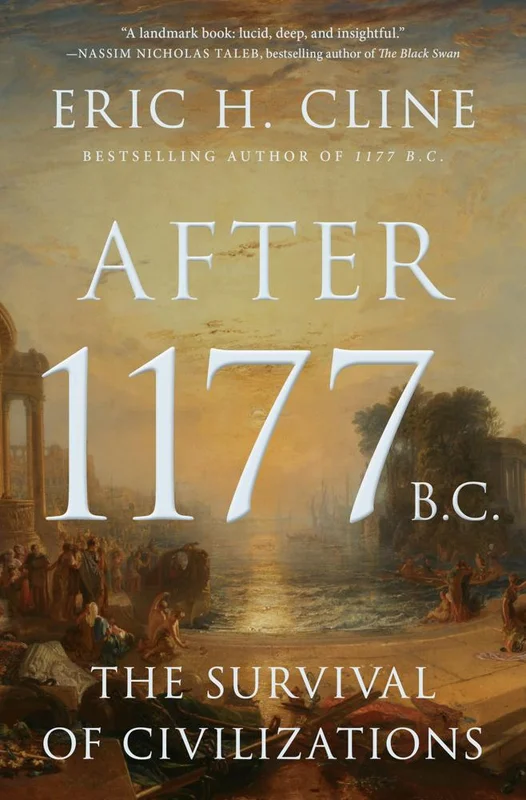
Description
By (author) Cline Eric H.
:
In this gripping sequel to his bestselling 1177 B.C., Eric Cline tells the story of what happened after the Bronze Age collapsed—why some civilizations endured, why some gave way to new ones, and why some disappeared forever
“A landmark book: lucid, deep, and insightful. . . . You cannot understand human civilization and self-organization without studying what happened on, before, and after 1177 B.C.”—Nassim Nicholas Taleb, bestselling author of The Black Swan
At the end of the acclaimed history 1177 B.C., many of the Late Bronze Age civilizations of the Aegean and Eastern Mediterranean lay in ruins, undone by invasion, revolt, natural disasters, famine, and the demise of international trade. An interconnected world that had boasted major empires and societies, relative peace, robust commerce, and monumental architecture was lost and the so-called First Dark Age had begun. Now, in After 1177 B.C., Eric Cline tells the compelling story of what happened next, over four centuries, across the Aegean and Eastern Mediterranean world. It is a story of resilience, transformation, and success, as well as failures, in an age of chaos and reconfiguration.
After 1177 B.C. tells how the collapse of powerful Late Bronze Age civilizations created new circumstances to which people and societies had to adapt. Those that failed to adjust disappeared from the world stage, while others transformed themselves, resulting in a new world order that included Phoenicians, Philistines, Israelites, Neo-Hittites, Neo-Assyrians, and Neo-Babylonians. Taking the story up to the resurgence of Greece marked by the first Olympic Games in 776 B.C., the book also describes how world-changing innovations such as the use of iron and the alphabet emerged amid the chaos.
Filled with lessons for today”s world about why some societies survive massive shocks while others do not, After 1177 B.C. reveals why this period, far from being the First Dark Age, was a new age with new inventions and new opportunities.
Review quote:
“Expert, ingenious and endlessly fascinating. . . . First in 1177 B.C. and now in After 1177 B.C., Mr. Cline has rewritten our understanding of a distant but resonant age.”
—Dominic Green, Wall Street Journal
Review quote:
“Brilliant. . . . A superb work to interest history buffs for every period.”
—Kirkus, starred review
Review quote:
“Cline distills an immense amount of material into a highly readable narrative that in its conclusion draws startling parallels with contemporary climate change. It’s a dizzying feat of scholarship.”
—Publishers Weekly, starred review
Review quote:
“
Cline is one of those rare scholars with the gift of communicating scientific and historical data to the public, joining the ranks of Jared Diamond, Ian Morris, Niall Ferguson, and others.
“
—Thomas E. Levy, Science
Review quote:
“Where [1177 B.C.] offered an almost relentlessly grim depiction of decline and fall, [After 1177 B.C.] gives us a more granular, detailed look at how different societies coped with the transformations of the Late Bronze Age collapse in contrasting ways. . . . Curiously reassuring.”
—Richard Kreitner, Slate
Review quote:
“Sequels aren”t just for Hollywood blockbusters. Historian Eric H. Cline enjoyed a huge hit with his book about the end of the Bronze Age. In 1177 B.C.:The Year Civilization Collapsed he showed how remarkably interconnected the ancient world was some 3000 years ago and how that and a convergence of events led to its downfall and the First Dark Ages. Now what? That”s the question he answers in After 1177 B.C., showing which nations rebuilt themselves, which n

Reviews
There are no reviews yet.