
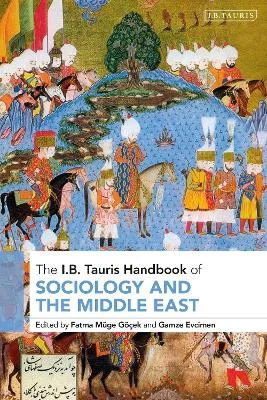
Description
Edited by Göçek, Fatma Müge; Edited by Evcimen, Gamze
Short /annotation:
The first handbook dedicated to the contributions of sociologists studying the Middle East, bringing together the 50 leading specialists in the field
:
What we understand by the ‘Middle East’ has changed over time and across space. While scholars agree that the geographical ‘core’ of the Middle East is the Arabian Peninsula, the boundaries are less clear. How far back in time should we go to define the Middle East? How far south and east should we move on the African continent? And how do we deal with the minority religions in the region, and those who migrate to the West?
Across this handbook’s 52 chapters, the leading sociologists writing on the Middle East share their standpoint on these questions. Taking the featured scholars as constitutive of the field, the handbook reshapes studies on the region by piecing together our knowledge on the Middle East from their path-defining contributions. The volume is divided into four parts covering sociologists’ perspectives on:
·Social transformations and social conflict; from Israel-Palestine and the Iranian Revolution, to the Arab Uprisings and the Syrian War
·The region’s economic, religious and political activities; including the impact of the spread of Western modernity; the effects of neo-liberalism; and how Islam shapes the region’s life and politics
·People’s everyday practices as they have shaped our understanding of culture, consumption, gender and sexuality
·The diasporas from the Middle East in Europe and North America, which put the Middle East in dialogue with other regions of the world.
The global approach and wide-ranging topics represent how sociologists enable us to redefine the boundaries and identities of the Middle East today.
Table of contents:
Introduction by Fatma Müge Göçek & Gamze Evcimen.
Part I. Pivotal Moments.
Introduction to Part I by Gamze Evcimen & Fatma Müge Göçek.
I.Israel and Palestine.
Segregation and Commingling: Jews and Palestinians in Israel’s New Mixed Towns by Gershon Shafir
Neoliberal Apartheid in Palestine by Andy Clarno.
Constructing a Sense of ‘We’ Across Conflict Lines: Joint Israeli-Palestinian Peace Movement Organizations by Michelle Gawerc.
II.Iranian Revolution.
Ideology and Political Action in the Iranian Revolution by Misagh Parsa.
Gender Politics and the State in Postrevolutionary Iran by Nazanin Shahrokni
III.Arab Uprisings and Egypt
Front Stage and Back: Assessing ‘Transition’, Citizenship, And Violence in the 2011 Arab Uprisings by Benoit Challand.
Historicizing Space and Mobilization in Tahrir Square by Atef Said.
Dual Refusal: How the Labour Movement almost toppled the Bahraini Monarchy by Amy Austin Holmes.
Ten Years On: Assessing the Outcomes of The Arab Spring for Bahraini Women by Magdalena Karolak.
IV.Syrian War and Refugees.
Extractive Landscapes: The Case of the Jordan Refugee Compact by Julia Morris.
Schooling in an Environment of Uncertainties: The Case of Syrian Refugee Children in Turkey by Çetin Çelik & Ahmet Içduygu.
Part II. Public Formal Space: State and Politics.
Introduction to Part II by Gamze Evcimen & Fatma Müge Göçek.
I.Development, Finance and Neoliberalism..
Before the Boom: Oil Wealth, Shariah Scholars, and the Birth of the Islamic Finance Industry by Ryan Calder
The Islamic Ethic and the Spirit of Turkish Capitalism: A Neoliberal History Making by Yildiz Atasoy.
II.Religion, Politics and Lifestyles of Islam..
Islam As an Experiment in Global Citizenship by Mohammed Bamyeh.
When Do Muslims Vote Islamic? by Charles Ku


Reviews
There are no reviews yet.