
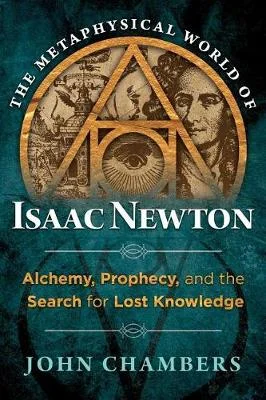
Description
By (author) Chambers, John
Short /annotation
Newton’s heretical writings on theology, spirituality, alchemy, and prophecy, uncovered and analyzed.
Newton’s heretical writings on theology, spirituality, alchemy, and prophecy, uncovered and analyzed.
Isaac Newton (1643-1727) is still regarded by the world as the greatest scientist who ever lived. He invented calculus, discovered the binomial theorem, explained the rainbow, built the first reflecting telescope, and explained the force of gravity. In his famous masterpiece, Principia Mathematica, he described the mechanics of the physical universe with unimagined precision, proving the cosmos was put together according to laws. The perfection of these laws implied a perfect legislator. To Newton, they were proof that God existed. At the same time Newton was writing Principia Mathematica, he was writing a twin volume that he might have called, had it been completed, Principia Theologia—Principles of Theology. This other masterpiece of Newton, kept secret because of the heresies it contained, consists of thousands of essays providing equation-incisive answers to the spiritual questions that have plagued mankind through the ages. Examining Newton’s secret writings, John Chambers shows how his brilliance extended into alchemy, spirituality, the search for lost continents such as Atlantis, and a quest to uncover the “corrupted texts” that were rife in the Bibles of his time. Although he was a devout Christian, Newton’s work on the Bible was focused not on restoring the original Jewish and Christian texts but on rediscovering the one true religion that existed prior to the Flood of Noah, when science and spirituality were one. The author shows that a single thread runs through Newton’s metaphysical explorations: He is attempting to chart the descent of man’s soul from perfection to the present day. The author also examines Newton’s alternate timeline of ancient history and his study of prophecy through the Book of Revelations, including his prediction of an Apocalypse in the year 2060 followed by a radically transformed world. He shows that Newton’s great hope was that these writings would provide a moral compass for humanity as it embarked upon the great enterprise that became our technological world.
Table of contents
Acknowledgments
ONE “A History of the Corruption of the Soul of Man”
TWO The Newton Code
THREE Newton’s God
FOUR Bloodbath in a Boghouse: Murder in the Fourth Century AD,
Part 1
FIVE The Severed Hand: Murder in the Fourth Century AD, Part 2
SIX The Temptation of Saint Anthony
SEVEN The Great Apostasy
EIGHT Apocalypse 2060?
NINE The Conversion of the Jews
TEN With Noah on the Mountaintop
ELEVEN In the Days of the Comet
TWELVE Deconstructing Time
THIRTEEN Chiron and the Star Globe
FOURTEEN A Glitter of Atlantis
FIFTEEN The Secret of Life
SIXTEEN Masters of the Prisca Sapientia, Part 1: Aristarchus, Anaxagoras, Numa Pompilius
SEVENTEEN Masters of the Prisca Sapientia, Part 2: Philolaus, Pythagoras, Moses, Pauli
EIGHTEEN Son of Archimedes
APPENDIX A Newton’s Prophetic Hieroglyphs
APPENDIX B Further Corruptions Found in the New Testament
APPENDIX C Newton’s Twenty-Three Queries Concerning the Word ὁμοούσιος
APPENDIX D Newton on God’s Anti-Trinitarian Introduction to John’s Book of Revelation
APPENDIX E Newton on Ancient Science
APPENDIX F Newton’s Translation of the Emerald Tablet
Notes
Bibliography
Index
Review quote
John Chambers has undertaken the valuable task of reemphasizing that a father o



Reviews
There are no reviews yet.